
A TAXONOMY OF ANTIZIONISM

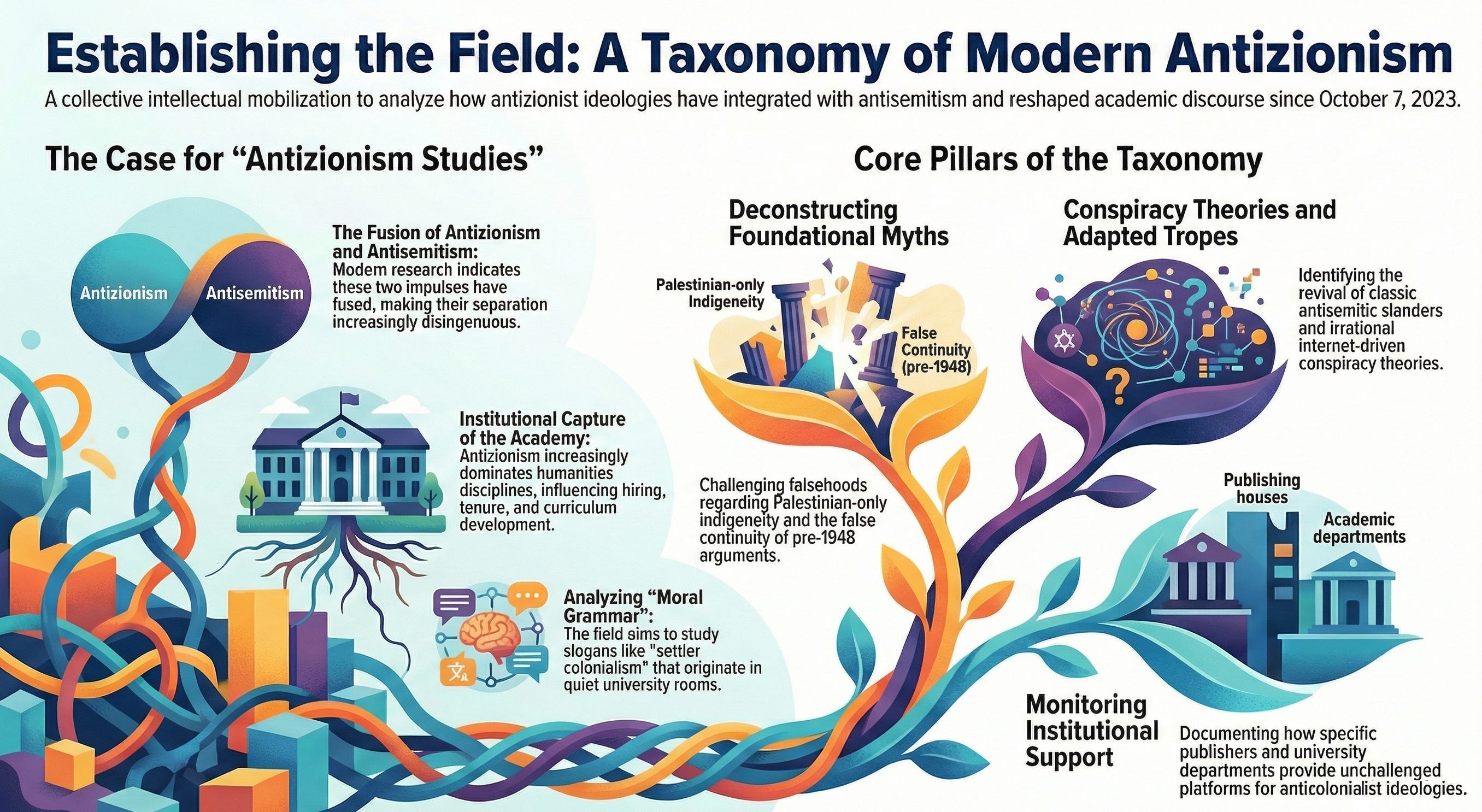
The South Africa-born Israeli cultural analyst and journalist Samuel J. Hyde recently called for “a collective intellectual mobilization” to “make antizionism a field of study.” [1] The formal study of antizionism would become a recognized field or subfield producing a much larger body of scholarship, the subject of multiple university courses and lecture series, and an effective funding infrastructure to help the work flourish. The two years of campus and community radical, overtly antisemitic antizionism that have swept Western countries since 10/7/23 have made some aware that much more dedicated and collaborative work by faculty members is needed if antizionism is to be analyzed and understood. As Hyde writes,
The young people who chant for intifada and denounce Zionism with quasi-religious conviction do not believe themselves ignorant. The believe themselves enlightened. The slogans that saturate social platforms, colonialism, decolonization, and the genocide libel did not originate in the fevered minds of the naïve but in the quiet, tenured rooms of the university. The have become the moral grammar of our time and are being wielded to sanctify the murder of Israeli Jews on October 7th.
As I have argued in a series of books—Israel Denial: Anti-Zionism, Anti-Semitism, and the Faculty Campaign against the Jewish State (2019), Hate Speech and Academic Freedom: The Antisemitic Assault on Basic Principles (2024),Mindless: What Happened to Universities (2025), and College Zionists Confront the Abyss: The Aftermath of October 7 in Higher Education and its Consequences for Progressive Politics, (2026)—and as Hyde clearly recognizes, faculty members have been the vanguard of efforts to elaborate, rationalize, and disseminate antizionist arguments. Their efforts underwrite the demonstrations that have made antizionist activism the core commitment of the contemporary left. Israel Denial, Hate Speech and Academic Freedom, and College Zionists Confront the Abyss form a trilogy on antizionism and antisemitism. The elaborate close readings of individual anzionist faculty careers that they include begin with sheer misrepresentation of fact and proceed to reveal core ideological agendas.
There is a growing academic community devoted to studying the antisemitic consequences of antizionism. Programs like Indiana University’s Institute for the Study of Contemporary Antisemitism (ISCA) to the London Centre for the Study of Contemporary Antisemitism (LCSCA), and The Institute for the Study of Global Antisemitism & Policy (ISGAP) are organizing conferences and producing a growing body of scholarship devoted to detailing antisemitism’s history and impact. Individual campus groups in Canada, Europe, and the US have enriched that work with international conferences that have documented the work on antisemitism that both young and established scholars are doing. But work exclusively focused on contemporary antizionism remains limited. We need to arrange several international conferences focused exclusively on antizionism.
Meanwhile, antizionism is itself being aggressively promoted by faculty members, campus groups, and NGOs that advocate for a cluster of historical and contemporary myths and falsehoods.
The first of these antizionist myths, one invoked for decades but not the main emphasis of contemporary antizionism, is the insistence that Palestinians are the only true indigenous residents of the area from the Mediterranean Sea to the Jordan River and beyond. It is based on the lie that the Jews have not had a substantial presence in the region either in the ancient world nor in the post-Roman era. This falsehood has been repeated for decades despite the substantial body of historical testimony and archeological evidence to the contrary. It remains a comforting story antizionists can tell themselves and use in persuading gullible new recruits to the movement that the antizionist cause has decisive historical validation. Given its historical claim, it can be considered antizionism’s foundation story. I have long argued that debates about indigeneity are fruitless. Even though a distinctly Palestinian, as opposed to an Arab, identity is a phenomenon of rather recent vintage, it is now a political reality. The bottom line is that the two peoples have to find a way of living together. A contest over origins will not solve the conflict.
The second example is the myth that there is a direct line between several antizionisms that flourished in the early twentieth century and those that operate today. The study of antizionism should insist instead that the establishment of the state of Israel in 1948 created a complete break with the antizionism that existed beforehand. Contemporary antizionism, like that Jewish Voice for Peace or Students for Justice in Palestine advocate, gains credibility and authenticity if people can believe it inherits the mantle of those who opposed the establishment of a Jewish state seventy-five or a hundred years ago. Efforts to eliminate an actual state with 7 million Jewish citizens bear no relationship, post-Holocaust, with earlier arguments that assimilation into European societies represents a solution preferable to Jewish statehood. Antizionism was once a plausible political argument when the outcome of history was still being debated. No longer.
Orthodox Jews traditionally opposed Zionism on theological grounds, but that belief lost its persuasive power with the Holocaust and the establishment of the State of Israel. There are remnants of Jewish groups opposed to Israel’s existence, notably the Satmar Jews, who believe only the Messiah can found a Jewish state, but they are politically irrelevant.
The third falsehood to be overcome is the insistence that contemporary antizionism is entirely distinct from and unrelated to antisemitism. Even relentlessly, often viciously antizionist groups like Students and Faculty for Justice in Palestine persist on claiming they are not antisemitic. They routinely perform outrage at the suggestion their practices actually erase the difference between antizionism and antisemitism. Among those seriously researching antizionism, a consensus has evolved, in the wake of 10/7, that antisemitism and antizionism have fused. With the antisemitic murders on !0/7 itself, followed most recently by the carefully planned slaughter of 15 Jews on Australia’s Bondi Beach, along with the belated recognition that chanted antizionist slogans have antisemitic consequences, that conclusion has become fundamental. It alerts us to the ways rationalized antizionism can either sublimate or animate antisemitism, including antisemitic murder.
These are some of the flashpoints that highlight contemporary debate and that must feature in the work antizionism studies does. They can preface the articulation of contemporary antizionism’s key components. I want to begin listing those here, not with the hope of being comprehensive, but with the aim of initiating a taxonomy that a antizionism should produce if it is to be an adequate field of study. I will include both philosophical/political components of antizionism and major elements of the social conditions that sustain it., as I believe antizionism studies should engage both dimensions. Here is a preliminary list of twenty, with light annotations:
1) ANTIZIONISM = ANTISEMITISM. This is the founding principle of antizionism studies. One need not continue to debate this premise. Elaborating why this is true while defending Zionism is our first task. Contemporary antizionism cannot, however, simply be conceptualized as identical with the dominant forms of antisemitism that preceeded it. The antizionism we face today is a new form of antisemitism and needs to be analyzed and resisted in its own right.
2) CORRUPTING THE ACADEMY. Antizionism now centers and defines the international left. It has entirely taken over the movement that purports to advocate for Palestinian rights. It is increasingly corrupting humanities and social science disciplines, making it nearly impossible to hire or grant tenure to faculty with research projects sympathetic to Zionism. Antizionism has turned several colleges of education, social work, and medicine into hostile environments for Jews. In Britain, London’s entire School of Oriental and African Studies (SOAS) is programmatically committed to antizionism. People who simply exhibit their Zionism off campus are equally in danger of ostracism or nonrenewal. Antizionism is increasingly dominating both Israel Studies and Jewish Studies, We need to be both frank and explicit in detailing these developments.
3) POLITICIZING THE ACADEMY. Antizionism has proven to be the primary engine behind the overall political polarization of the academy. It disparages or outright rejects debate and dialogue between people with opposing views. It elevates discrimination against political opponents to a moral virtue.
4) ANTIZIONISM’S KEY CLAIMS. We would benefit from a collective project to monitor and detail contemporary antizionism’s key claims. That would include the claim that Israel is a settler colonialist state, that Zionism was motivated by a genocidal drive from the outset.
5) ANTIZIONISM’S CONSPIRACY THEORIES. As distinct from its key claims, which are sustained by a pretense of rationality, antizionism’s conspiracy theories, including the false accusations about Israel’s actions, indulge irrational fantasies and delusions that persist despite being either unprovable or disproven. The internet has helped thoroughly irrational conspiracies gain purchase amongst eager or gullible populations: Zionists or Israelis invented COVID, they planned the 9/11 attacks; murders of Jews are really staged false flag events.
6) ARGUMENTATIVE STRUCTURES. Detailed analysis of antizionist writings and manifestos will make it possible to produce a taxonomy of the major arguments that dominate contemporary antizionism.
7) ADAPTATION OF HISTORICAL ANTISEMITIC TROPES. No rhetorical and political strategy is more insidious than the contemporary revival and adaptation of classic antisemitic tropes, whether it be the fantasy that Jews aim to control world finances or the media or dominate world politics, the belief that Judaism poisons Western culture, or the slander that Jews seek to kill or kidnap the children of their opponents or harvest Palestinian organs.
8) ISLAMIST ANTIZIONISM/ANTISEMITISM. Confused, manufactured guilt about and fear of the accusation of Islamophobia has blocked understanding of the mortal dangers Jews can face in Western countries. Campus efforts to combat antisemitism are often irresponsibly combined with plans to combat the substantially less serious presence of Islamophobia in the US. Unlike antisemitism, Islamophphobia is not a serious force on US campuses. What other project to combat a powerful form of hatred requires that it be paired with an unrelated prejudice? Antizionist studies can counter the fiction of Islamophobia with facts.
9) ASSAULTS ON HOLOCAUST STUDIES. One of antizionism’s central strategies is to undermine the central role the Holocaust plays in our understanding of modern antisemitism and modern history more broadly. Antizionism studies overall needs to be responsive and committed to both the analysis and the critique of those initiatives, among them efforts to minimize the Holocaust or transfer its moral status to violence against Palestinians. It’s not clear that complete neutrality on the topic is possible.
10) ARAB ANTIZIONISM/ANTISEMITISM. The study of antizionism cannot proceed without accounting for the various forms of regional hostility that Israel currently faces. In addition to its historic roots in Islam, its twentieth century metamorphoses merit much more elaborate study. Research has documented the impact that Nazi propaganda had on Arab antisemitism.
11) JEWISH ANTIZIONISM. This may well be the most painful topic to address, but we must do so. Some Jewish students are active in Students for Justice in Palestine or Jewish Voice for Peace, both of which organizations are officially devoted to antizionism. A few Jewish faculty members are prominent in their campus chapters of the resolutely antizionist or antisemitic Faculty for Justice in Palestine. Jewish antizionism/antisemitism needs to be a defined area of study within antizionism studies. Its psychodynamics, its family entanglements, as yet undefined, differentiate it from all other versions of antizionism.
12) CAPTURED JEWISH STUDIES PROGRAMS. This element of the previous point deserves a separate entry. A number of Jewish Studies or Israel Studies programs throughout the US are now dominated by their antizionist faculty members. Others are decisively polarized. An antizionist program executive committee may represent majority faculty opinion or it may represent the fruits of organized political capture in a divided program. Zionist students and faculty then experience serious alienation. They are without a true academic home. Donors who thought they were creating a program committed to a Jewish state feel betrayed. There is no easy solution. But it should be possible to create programs grounded in the core belief that israel has a right to exist as a Jewish state.
13) IDEOSYNCRATIC ANTIZIONIST PROFILES. In addition to tracking common elements in antizionist profiles we need to recognize the emergence of unique individual voices that can influence the movement. Faculty often strive to make original contributions, an impulse that helps antizionism invent new arguments and strategies. Detailed analysis of individual antizionist projects is one of our recurrent tasks
14) ACADEMIC PUBLICATION AND SOCIAL MEDIA USE. The similarities and differences between purportedly scholarly publications and political agitation through social media need to be thoroughly studied. We now have high quality research groups both in North America and Europe doing ground-breaking work on antisemitism in social media that will make such comparisons possible. Are the differences ones of intensity or substance? What happens when antizionist academic publications and social media activity are combined to create one professional profile?
15) EVOLUTION OF CONTEMPORARY ANTIZIONISM. Just as antisemitism has mutated over centuries, so too does antizionism evolve significantly in the contemporary world. Prior to 10/7, for example, antizionists waged political battles over the alternative choices of two state or one-state solutions to the Israeli/Palestinian conflict. On 10/8, antizionist interest in a 2-state solution seemed instantly to disappear. The foundational crime was no longer the capture of Gaza and the West Bank in 1967 but rather the founding of the Jewish state in 1948. Antizionism also evolved by redefining genocide so that the intent literally to eliminate a people was no longer necessary; genocide became a moral and political accusation certified by belief in a nation’s essential depravity, rather than a precise legal category to be adjudicated with facts.
16) FEATURES FUSING ANTIZIONISM AND ANTISEMITISM. To counter the self-righteous severing of the two impulses, one must go well beyond the BDS movement’s unsupported insistence that the two are separate. What elements do they share in common? How have contemporary movements driven them together? What are the observable consequences of their fusion? One can begin by enumerating the political program they have in common, then move to the ideological, rhetorical, and psychological impulses they share.
17) SOCIAL STRUCTURES REINFORCING AND REWARDING ANTIZIONISM. Antizionism today is clearly not just a theoretical construct. It is a social and political movement facilitated by personal relations and exclusions, by psychological constraint and affirmation. We need identify those processes and reflect on whether they can be interrupted. Special attention should be given to the identity positions that antizionism, as opposed to antisemitism, offers to students, faculty, and community members.
18) ANTIZIONIST NETWORKING. Both through social media and through face-to-face meetings antizionists promote a national and international agenda. One needs to discover how not only ideas but also activist goals and plans spread. The communication opportunities social media offers enabled the 2024 encampment movement to spread without central coordination.
19) INSTITUTIONAL SUPPORT FOR ANTIZIONISM. There are publishers, among them the University of California Press within the academy and Haymarket Books outside it, that specialize in building antizionist lists. There are universities, among them Columbia University, the University of Illinois, CUNY, and the University of California system, that have allowed uniformly antizionist academic departments to flourish without objection or oversight. Institutional support for research on antizionism lags in key areas. There are not enough academic journals devoted to the study of either antisemitism or antizionism. The existing ones as a result are burdened with disabling backlogs and cannot publish research in a timely manner.
20) MONITORING ANTIZIONIST DISCIPLINES. Antizionist academic departments are often inspired by national and international academic disciplines that are fiercely devoted to antizionism. Middle Eastern Studies, Women’s Studies, American Studies, Anthropology, Psychology, and African American Studies are notable examples. The condition of those disciplines need to be documented and their impact on higher education resisted when it is clear they impose uniform political conclusions on their students. The governing principle here is that no educational practices should be cloaked from scrutiny and evaluation.
21) GOVERNMENT INTERVENTIONS. We are seeing increasing government interventions in the institutional practices that promote or counter antisemitism. These interventions are proving at once helpful and counter-productive. By threatening to withdraw large amounts of funding, the US government got universities’ attention in a way nothing had done before, but the government also challenged basic university authority over academic policies and practices. Absent government pressure it is unclear universities will adopt necessary reforms. But government assaults on intellectual independence are a grave theat to higher education. Antizionism studies scholars need to play a role in monitoring and advising those initiatives. Zionist classrooms should study them.
22) ANTISEMITISM AWARENESS TRAINING. Opposition from antizionists notwithstanding, antizionist awareness training is essential to reducing prejudice and restoring civilized behavior on campuses. Zionist scholars should study and teach the results. Training that encompasses both the history of antisemitism and the ways in which its contemporary manifestations adapt traditional tropes cannot be adequately provided by one brief video. Nonetheless, something is better than nothing. The trend of combining antisemitism with Islamophobia awareness training, thereby treating them as equivalent biases, is an illegitimate concession to antizionist constituencies.
23) COHERENT IDEOLOGY. Antizionism is not only hostility toward Jewish nationalism. It increasingly constitutes a coherent ideology that possesses a relative autonomy with aggressive ambitions all its own. Antizionism aims to become a supra-ideology, the fictitious driving engine behind all authentic causes serving political justice. It offers itself as the necessary mirror image of the fantasy image of the Jewish attempt to control the world. That agenda threatens Jews worldwide with inner exile within the nations of the Diaspora.
No one person would be expected to contribute to all the areas of concern above, but the overall study of antizionism would benefit from shared awareness of its full dimensions. That knowledge can facilitate faculty recruitment and program development. The list above advocates for a field of research; its objects of study include both discourses and contemporary political practices. There is an activist component that can follow from the knowledge the study of antizionism produces. But it should not be a requirement of participation in the academic enterprise. One can, for example, gather the evidence that a supposedly scholarly discipline is devoted to indoctrinating students but leave it to others to intervene in its operation. Antizionism tends to make activism a moral imperative for its followers, but the study of antizionism should not imitate that requirement. To coerce political compliance and activism corrupts the free and open debate an academic field must encompass.
My own original research on antizionism is represented by the books listed above. It includes a group of exceptionally detailed essays on the publications and careers of individual antizionist faculty, ranging from Judith Butler to Lsra Sheehi, along with several studies of the BDS movement and a thorough analysis of the 2024 campus encampments. I have also battled BDS resolutions in a series of academic associations, though I have never taught my students how to do so. Similarly, I was faculty advisor to the local graduate employee union for a decade, but I never advocated for the union in my graduate seminars. The fatally politicized disciplines have all erased the line that divides the classroom from the demonstration.
That said, I do wish that more Jewish faculty would passively support those Zionist advocacy projects focused on supporting community members and their academic work. Most silent Jewish faculty are not hostile. They are just afraid. They think they will be held harmless if they keep their heads down. History offer little support for that confidence. Yet many Zionist faculty would hesitate even to endorse a project merely to organize research on antizionism.
Is it possible to oppose Israeli government policies with embracing antizionism. Certainly. Israelis themselves do it every day. Is it possible to adopt a categorical anti-Israelism without taking on antizionism’s whole ideological agenda? Perhaps it once was, but that day has passed.
Finally, as the analysis above suggests, whether or not antizionism was ever comprehensively separate from antisemitism, it no longer is. The study of antizionism is entangled both with the last 150 years of antisemitism and with the longest hatred’s whole history. But one cannot successfully engage with contemporary antizionism without granting the two overlapping hostile traditions a degree of relative autonomy. For one thing a great deal of faculty research declares its commitment to antizionism alone. Deluded, disingenuous or not, we need to know what practices that commitment includes. Granting the two impulses relative autonomy also opens awareness of how explicit antizionism disguises, trivializes, discounts, and inspires antisemitism. Making antizionism a recognized field of study will help us construct the necessary body of knowledge. It certainly deserves a place within institutes and programs that study antisemitism.
Cary Nelson is Jubilee Professor of Liberal Arts & Sciences emeritus at the University of Illinois Urbana-Champaign and an ISGAP faculty member. Three of his authored books—Israel Denial (2019), Hate Speech and Academic Freedom (2024) and College Zionists Confront the Abyss (2026)—form a trilogy on antizionism. He is a former president of the AAUP. He holds an honorary doctorate from Ben-Gurion University of the Negev.
[1] Samuel J. Hyde, ”It’s time to Make Antizionism a Field of Study,” Substack--Beyond Belief (November 16, 2025),

. The Connecticut philosopher Andrew Pessin has also been advocating antizionism as a field of study. My thanks to Michael Saenger, Jim Wald , and several members of the Alliance for Academic Freedom for comments on a draft of this essay. Ori Freiman used AI to create the graphic version of the essay.